Saturday, May 12, 2012

Veggie Garden 2.0

If you wait long enough, maybe everything will happen—for instance, my 2 and a half year old broccoli finally headed out this spring! Near the end of March I used a tripod of bamboo poles to lift the stalks up off the ground so it wouldn't be quite so easy for the slugs to get the new growth.


A couple weeks later the flowers were ripe and ready to eat, so I cut most of the little heads off. I got one nice big serving off the two stalks, and it was great! I haven't eaten anything but frozen broccoli for so long that I was surprised how much flavor this had. There is a nice big clump of sprouts from the bottom of one of the stalks that I'm going to thin out and let grow. I suspect they started because the stalks had lain horizontal on the ground from the first big windstorm last fall until I picked them up off the ground this spring. Maybe this is just a really long-lived broccoli.


I left a few bits to flower because they were really too small to bother with, and the companion plant book says they'll attract good bugs. They're almost ready to bloom now. I let the rhubarb flower for the same reason, plus I wanted to see what it looked like.

By that time, the garlic and onions that got left in the ground last year because their tops disappeared had sprouted again, so I pulled up the garlic, divided each one into single cloves, and replanted them. I hope they'll get a little bigger this year; the biggest one I had was only 6 cloves. And I hope I can manage to harvest most of them this year! With a little luck, I'll get them replanted in October this year, when they're supposed to be planted.

I planted several different companion flowers in with the veggies this year—calendulas, gaillardias, alyssum, and cosmos. Even if they don't attract enough good bugs to make a difference, I really like having them just because they make my garden look better—and I love flowers. I just put them in a few weeks ago, so they haven't done much yet, but they are growing.

I made two other changes to the garden as a whole. I stapled up some 3-mil plastic along the fenceline to do three things: To stop me from watering the weeds in the pasture next to the garden; to keep the weeds from leaning into my garden and dropping seed; and to create a small, possibly slightly warmer microclimate. It will also partially block the really hot dry chinooks we get in the summer. The second change is my new permanent paths. The previous owners left me a pile of short cedar fence pieces and strips of plywood that I had never gotten around to getting rid of, and they make somewhat satisfactory pathways. This was another recommendation in the companion plant book, to reduce soil compaction from walking and to reduce the amount of mulch you need.

The peas, broccoli and kale that went in first are doing great! After the weather really started to warm up I thinned them, although I see from this picture that I didn't get all the extra broccolis. I hate thinning—it seems like I'm wasting plants—but some of the sprouts were so close in the packs that I couldn't divide them as I was planting.

The peas are growing great guns now, and the biggest of the little brocs are almost a foot tall.

The kale is bushier than it is tall, but it's looking really good. I've had to keep putting out snail bait, and I almost lost one of the little plants. Those are calendulas in front of them.


I really wanted to grow parsley this year because I love cooking with it and it seems so silly to buy it when you can grow it. I think I'm really getting into growing herbs. I'm not that much of a cook. Period. But so far they're easy to grow, and it's really nice to have fresh spices when you do want them. Parsley is so good with potatoes or on garlic bread. So when it warmed up a bit I put a 6-pak in next to the garlic, except for one I put in a patio pot in case the slugs got the garden ones. It's taking them a little while to settle in, but now that we're getting some warm weather I think they're getting happier.


I did make one purchasing error this year when I was buying spices. I grabbed a tarragon that looked lovely but when I got it home I found out it had no aroma at all, and I couldn't understand why not until I came across Russian tarragon on the web yesterday. It's a different species that is described as having little or no flavor (!) but growers sell it because it makes viable seed and is easier to propogate than French tarragon which can only be propogated asexually. So now I have to try and find the good stuff and keep it alive through the winter. Nominally I'm in zone 8b, but the strong winds, heavy rains and heavy clay combine to make some parts of my garden the equivalent of zone 6.

I turned out to have more potatoes this year than I planned on. I was only going to plant All Blues this year, because they were soooooo good last year. But as it got closer to  planting time, none of the stores were getting them in, so in desperation I bought some Purple Majesty, then Cherry Reds and Russian Banana fingerlings. After I had bought all of these, a farm supply ten miles away advertised on CraigsList that they had All Blues. I drove over there on a particularly cold, wet day, and they did have them, nice big fat sets, in fact bigger than any of my blues got last year. I couldn't help buying 5 sets, so at that point I had enough potatoes to fill up half the fenced area, twice as many as I had intended to grow. I resolved to start eating them sooner this year, so I won't have so many at the end of the season. I presprouted them again this year, and planted them the first week in April, the same as last year. I wasn't going down to the garden much during the two or three weeks of almost continuous rain we had, and when it finally stopped and I looked again, they had all popped up and were growing like crazy.


I have gotten one big surprise as the soil has warmed up the last few weeks—I missed harvesting at least a dozen potatoes! I've had potato sprouts all over where I planted them last year—and some of them were good-sized! And I thought I was so thorough.... I pulled all of them up except for some of the Rose Finn Apple fingerlings, which are where some of my herbs are growing this year. I didn't want them to mess up my rotation scheme, and honestly, I think I'll have enough potatoes. But this harvest, I'm going to have to be a lot better at digging them!

I haven't put any new hay down yet—there was still enough stuff down to keep weeds from sprouting, and I wanted to give the sun a chance to warm the soil as much as possible. I think it will be going down soon, though, just to keep the soil from drying out.

I think the biggest improvement for this year is that when it was time to plant, I had everything ready and the weather cooperated fully, so things got planted on time this year. So even though last year was a limited success, it was a great learning experience and I'm seeing the benefit of that now. Hope I can keep the momentum going.

Tuesday, April 3, 2012

Re-starting the garden

It's warm, then it's cold, then the sun comes out, then it starts to hail, then the wind comes up, then it rains, then it rains some more, then it rains another two inches...and there you have it—Spring! Time to re-start the garden!

Some of the first plants at Fred Meyer last month were their six-packs of veggies, and it was soon enough after payday that I decided to jump-start the garden and get something growing. I came home with kales, broccolies, and snow peas. I've never bought any plants this early before, and I was happy to find that none of them were root-bound—they were all at the perfect stage to plant out. I went out and scraped the oak leaves back enough to plant the babies, and got them in the ground. What was left of the hay was really matted down and far from the fluffy golden stuff I had last summer, but it was still covering most of the ground, and an inch or two thick where it still lay. However, there were enough bare spots that I was glad I had gotten the bags of oak leaves for additional cover. The leaves look practically new and I'm thinking they'll be lasting a while. But maybe they'll start rotting when the soil warms up and the micro-organisms get more active.

A row plus two of baby broccolis
Peas and their pea-rsonal trellis
Little kales
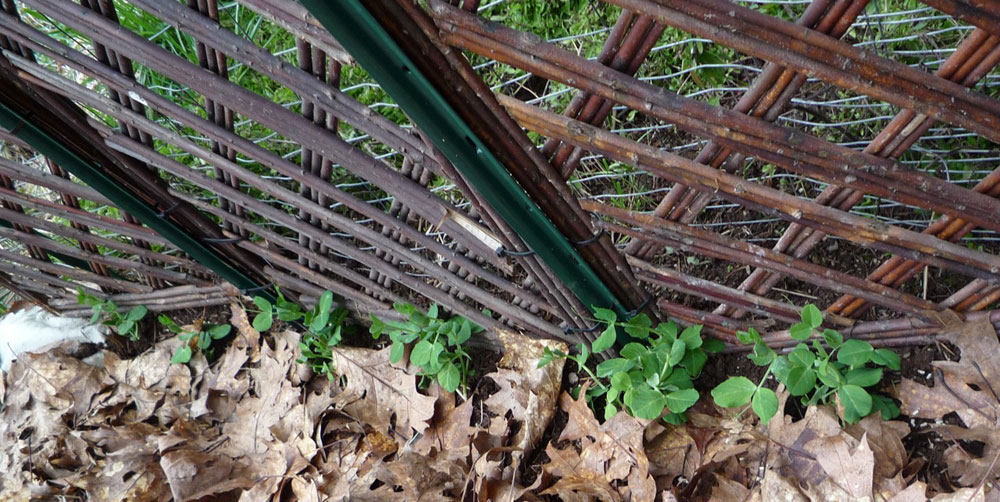
I dug some chicken manure into their beds, and had to use the big pick to break the hardpan where I put the kale. I had found some used willow trellises last summer on CraigsList and they hadn't found a place in the garden yet, so I decided to try them for the peas. I cable-tied them to the fence and stuck in an extra fence post to help hold them, and so far they seem pretty sturdy.

The next day there was seven inches of snow on the ground. I waddled down to the veggie garden in my wellies and took some pictures.

Most of the snow landed on the broccoli, close to the back fence.
The fruit trees all decorated.
A few days later, after the snow had melted, I went down to see if anything got snow-smushed, but everybody was fine. The kales had turned purple but were still alive. One kale did get slug-nibbled, so I put out slug bait. Snow and slugs. Sheesh.

So, I have a new garden! I also have a refrigerator drawer full of pre-sprouted potatoes, and they'll be going in during the next dry spell. I do have seeds to plant, too. I wanted to try kolrabi and bulb fennel again. But if I don't have any better luck with those this year, at least I'll have my cold-hardy things to eat. I have managed to clean out all the weeds left from last year, so it feels like a fresh, new garden.

It feels so good to be able to get out and work in it again, even if it is just one day a week.

Thursday, September 22, 2011

End of the season

Summer is almost gone, but it's sure going out with some beautiful style, with sunshine and nice cozy temperatures. I've been keeping an eye on the garden—and really enjoying the food I've gotten out of it so far, including my first potatoes—but have been too busy with other things to blog. The sun was up early today and when I looked outside about 7:30, it was coming through the trees and lighting up a bunch of stuff, so I grabbed the camera and went outside.

Bulbless kohlrabi
I had a few failures this year. The big one was the kohlrabis, which never developed bulbs. They ended up with inch-thick stalks and tons of leaves--this is a shot into the base of one—but when they started flowering and still didn't have bulbs, I dug them all up. I found one clue on the web that may be the problem—it said they won't develop bulbs if they're too close together. Mine were about 8" apart in two rows a foot apart. By the time they stopped growing they were really crowded, their leaves all tangled together, so maybe that was the issue.

My broccolis may still turn out to be a success, but I'm going to have to wait till next spring to find out, because they didn't get big enough to flower before the day length started to get shorter, and I think they just decided to wait till next year. They got really big, chest high and 18" across. Yesterday they both fell over:

Recumbent broccolis
I staked them up this morning. I'm sure the reason they fell was because the soil is so shallow there. I thought I had planted them over a spot where I had broken through the hardpan, but apparently not. So I'll wait and see if they make it through the winter. If they do, I should get a lot of broccoli in the spring!

The zucchini I had problems with early in the spring, with blossom end rot. I didn't know squash could get that, but I learned it's a problem in many cucurbits—squashes—including zucchini. It can be caused not just by insufficient calcium in the soil, but a number of other problems that keep the plant from being able to get enough calcium, even though the soil is fine. Among those are cold soil, and insufficient or irregular water. I know the water there has been hard to manage this year and I'm going to put them in a better spot and handle the watering differently next year. I've gotten 3 zukes off of it so far and there's one more on there now, but the clouds are coming in, the temperatures are going to be getting cooler soon, and I think this last one is going to be the end.

My big success was the peas—so many I could hardly keep up with them for a while:

Peas are just too cute
They were supposed to be snow peas, but I ended up eating most of them as peas because I left them on too long! And in my opinion, the peas were way tastier than the pods, even the ones that were young and flat.

My potatoes were the size winners—in fact, they got too big. I planted them in north-south rows, and they all ended up falling over and smothering whatever was east of them—garlic and onions, beans, fennel and squash. So next year I won't be planting quite as many, and I'll plant them in east-west rows, so they'll just fall over on each other. I did talk to a woman who grew potatoes in straw over in Bend, and she put 18" of straw on top of hers as they grew up. That would probably help keep them upright. The only ones that have died back completely have been the All Blues, and I've been pulling them out of the ground for the last week one or two at a time. I've gotten 4 so far from one plant, and have just been amazed at how much flavor they have. With olive oil and garlic salt on them, they're like the best potato chip I've ever eaten. Awesome.

This morning the other two rows, the Pontiac reds in front and the Rose Finn Apple Fingerlings on the upper right, are obviously winding down. The Pontiacs were 18" tall a month ago and 3 feet across (I'm not kidding), now they're only a few inches tall and you can see how much they've thinned out:
Tired potatoes and mildewy squash
I expect I'll have enough potatoes to eat for several months!

I don't have a picture of my garlic, either, but it did well for only being planted this spring. I dug up a couple little 3-5 clove heads two weeks ago to make garlic toast out of them, and they were great! I figure I'll just leave them in the ground, and maybe plant another 10 or so next month—when they're supposed to be planted! The onions I don't know about yet--they're under the potato plants, so I'll be able to get to them soon. The rhubarb grew really well all year, except they had some water problems too at one point. But I think I'll be able to get a good harvest from them next spring, most of the plants developed 6 stalks or more this year.

One other bit of garden eating I got to do was when I made the garlic toast, I garnished them with chopped sage and rosemary from my garden—and some store-bought parsley. Next year I'm definitely going to grow some parsley! Parsley, sage, rosemary and garlic—mmmmmmm! 

As far as the hay mulch is concerned, as a weed supressant and a moisture retainer it worked really great. The places that got too dry were places where I didn't have enough hay down. I did end up having to water 2-3 times a week when it got hot. Next year I'll try to do a better job of getting both the hay and the water distributed evenly. I also need to either get a different kind of sprinkler or use a soaker, or plant my plants better. The broccoli got so tall it ended up blocking the water to the rhubarb. The zucchini didn't have enough hay around it, but by the time I discovered that, the potatoes were overtaking both squash plants and it was really hard to get to anything.

I had one other success, that I haven't done anything with this year except enjoy looking at them—the cardoons:
Cardoon
I love the little artichoke buds! I keep thinking I'll cut some off and try cooking them—there are certainly enough to make a meal for me, even though they're small. Next year. They're beautiful plants, I love their leaves and their big size. Like the other stuff, I didn't put them in the most convenient spot, but they have done well in the crappy soil zone. I'll cover them with hay when they die back, and hope they'll make it through the winter. I definitely recommend them just for their looks! I have noticed their leaves seem extremely fragile—they make cracking noises every time I bump into one hard. Not for traffic lanes.

One more treat that's coming, if the deer don't jump in and eat them before they're ripe next month:

Liberty apple
I have three little apples about 2" across, on my Liberty apple. They've been slowly growing all summer and should be ready to harvest in a few weeks. I'm really not sure how to tell when they're ready if they don't fall off or pull off easily. They've been somewhat red since they were an inch across, so I don't think the color is going to help.

And one more treat that's technically outside the Ruth Stout garden, although I do mulch it with bark:

Canadice grapelets
My Canadice grape newly planted this spring surprised me with four bunches of grapes a few months ago. I broke off two of them and the two I left have been slowly growing. They're quite tiny—the big ones are pea-sized, not as big as this photo makes them look—but maybe they'll ripen. Don't know. Hope they do. They're red seedless. I don't even want to think about how sour they are right now.

So all in all, it's been a really interesting year, and a really interesting garden. I love Ruth Stout! I love hay mulch! I love my garden!

Saturday, July 2, 2011

Visions of beauty everywhere

 Last weekend I was fortunate to attend some of the open gardens during the Hardy Plant Society of Oregon Study Weekend in Portland, and I saw so many beautiful things, I'm still full of them. I wanted to share some of them. These are all from gardens in Portland except the peonies--they were at the Portland Saturday Market.

Peonies
Bronze Japanese Maple
Garden Guardian
You can't see me—I'm hiding
Rugosa Rosebuds
Papaver rhoeas and Stachys
Phlomis
Too lush for words
Allium christophii and Camassia
Rose arbors
Every week from mid-spring through mid-fall, members of the Hardy Plant Society of Oregon open their gardens for visiting. You can find them by joining HPSO, which you'll find at this website.

Wednesday, June 29, 2011

The orchard has landed!


Yaaaayyyyy! The fruit trees I've been holding in pots for two years since I bought them bare-root, are now in the ground! The weather has been really gardener-friendly the last couple mornings, and yesterday I went out and took another whack at the weeds. This morning it was 59º and thickly overcast, even had a little breeze, so I went down early with my tools and started digging out the holes I laid out last fall. I had to cut out a few roots left over from the since-departed cherry trees in almost all the holes, but the dirt wasn't really that bad, so I got all five trees planted in an hour and a half. In addition to the Shinseiki asian pear in the foreground, there are now a Liberty apple (with 3 little apples on it), a Chinese apricot, an Italian plum, a Bartlett pear, and a Montmorency cherry. They're all semi-dwarf, and I'll be keeping them all pruned pretty low, so there won't be any need for ladders. The ground is sloped enough that ladders would be a pain.

I'm really happy this is all done because this was a project four years in the making, from the time I first started wishing the big cherry trees could go away. All the potted trees had nice solid root balls except the apricot, which turned out to be sharing its pot with an ant colony. I expect they'll be leaving now that there's going to be a lot more water around. I hope so anyway. I would really like the apricot to be happy and healthy. And make me some apricots some day.


Five of my young cardoons are big enough that I'm pretty sure they'll make it. I'm keeping them sort of rabbit protected till they really get spikey and nasty, another month or so. They didn't do much of anything till a couple weeks ago when the temps started creeping up.


My potatoes grew another 2" this week! All of the plants are bigger, even the Rose Finn Apples, which shot up and are finally starting to look happy. I thought everybody had topped out last week when the first flowers appeared, so I have to wonder just how big these guys are going to get.

Two more pieces of good news—I have 6 healthy fennels and two runts, and my snow peas are blooming! So I should get a few pods soon. This warmer weather—and soil—are really making a difference.

Happy 4th of July, and happy gardening!

Wednesday, June 22, 2011

Warm enough for beans (I hope!)

I planted my bush beans today! I didn't check the soil temp at the garden, but it's 58º at the house, which gets a lot less sun. That is at the bottom end of the range for beans, but I've got a big package of seed if these don't come up. I'm afraid they're a little late to be much good as companion plants for the potatoes; I would have to plant the potatoes a month later for them to be growing together.

Here's what the spread looks like now:


The new little collards at the far left are unfortunately bolting already; I'll let them flower until I get some kale started. I won't bother with store-bought collard plants again, but I may try starting some seed again, around August, for the fall season.

Everything else is growing pretty well. The broccoli twins aren't showing any sign of heading yet. The one that went early is blooming nicely now.


The kohlrabis are big, but not showing any sign of forming bulbs yet. Wonder when that's supposed to start happening.


The peas are taller than the 39" fence, and I saw one flower bud today.


Five of the seven fennels I planted are still alive and seem to be growing well enough. I'm looking forward to harvesting them this fall.


The daikons were a bust! They're already flowering so today I dug up 4 of the biggest ones, and the only "radish" was an inch and a half long and no thicker than a pencil. Oh well. More flowers. Right above the radishes on the left you can see my baby zucchini clump. It's definitely growing like a zuke.


I put more hay up around all the taters—it's 10-12" now. I'm really not sure how well hay is going to work for keeping the spuds in the dark, but I'll know in a month or two. Front to back, these are the Rose Finn Apples, the All Blues, and the short row of Pontiacs. Took this before I planted the beans.


I saw how much bigger the Pontiacs were than either of the other two, and I thought, Wow! They must be a lot more vigorous!


Then I remembered that they're the only ones planted in the old manure pile soil—the other two are in the dusty sand of the corral. The All Blues still look pretty good, but the Rose Finn Apples look like they're struggling by comparison. They sprouted so much later than the others, maybe there's hope for them to catch up, they really are delicious little babies.

The hardy golden oregano I planted on two sides to block weeds is just wonderful—what a great, bright ground cover!


The big lupine is really showing off. Later I'll move him out to the orchard where he can have a permanent spot. At one point this was a single plant, and yet it now has three different kinds of flowers. Both it and the smaller one in its shadow were both volunteers.

As far as my hay mulch, I love it more than ever. I pulled apart several of the old soggy flakes today and this time I didn't find a single slug. Maybe the sluggo got a lot of them, but it's also obvious that even the formerly soggy flakes are now starting to dry out, and dry hay is no place for a slug. In contrast to the occasional spindly weed I'm finding now in the hay, they just keep sprouting all around outside, in the bare dirt.


This is the 4th crop of weeds in this spot just this year, I keep whacking and they keep coming. These guys' days are numbered. The hoe is coming! Beware the hoe!

Thursday, June 2, 2011

The secret of hay

I spent another afternoon in with the veggies a few days ago, and I think I understand the secret of using hay for mulch. If you take compacted hay, like that pressed into a flake or a bale, and let it get wet, it will hold the water just like a sponge would. How quickly it rots probably depends on how much of it is stem and how much is leaf, but my grass hay is not rotting quickly, even the flakes I'm using for paths and borders which have soaked up and are holding so much water it runs out when I touch them. Grass shoots sprout from their edges and will root where they touch the ground. You can throw another flake on top of it to stop the sprouting, but eventually it will sprout too, if it gets wet.

On the other hand, if you take the same flake of hay and pull it apart into loose strands before it gets wet, you can pile the loose strands up 8" deep, at least, and no matter how many inches of rain fall on it and through it, it will stay drained and dry, and will not sprout. Only the thinnest layer touching the ground will rot, and if it's thickly enough covered to keep light from getting through, none of it will sprout, and no seeds underneath it will sprout either.

That's why it works as mulch. Compressed hay—bad. Loose hay—good.

And it's still early in the season, I probably have more to learn.