Saturday, July 2, 2011

Visions of beauty everywhere

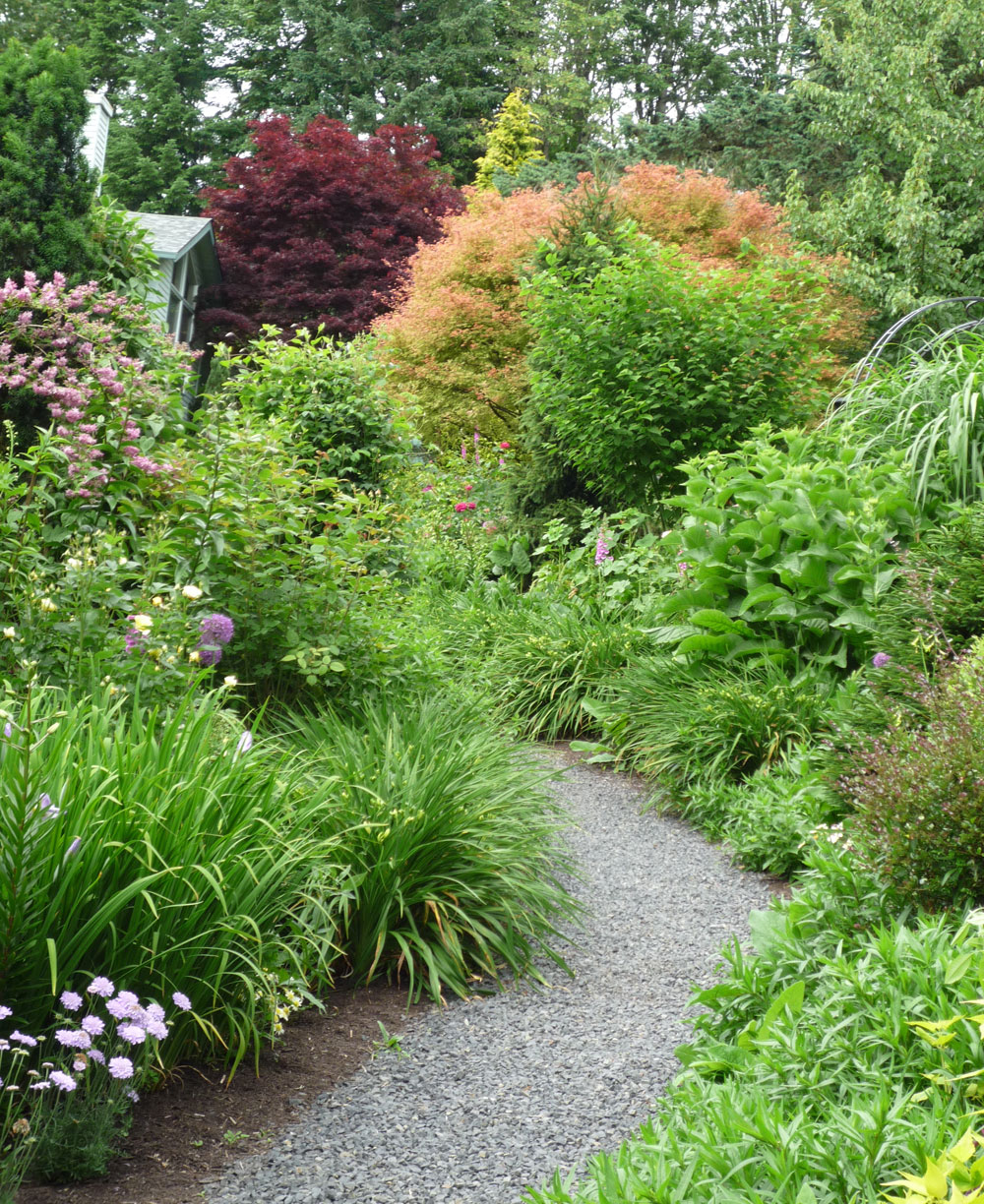
 Last weekend I was fortunate to attend some of the open gardens during the Hardy Plant Society of Oregon Study Weekend in Portland, and I saw so many beautiful things, I'm still full of them. I wanted to share some of them. These are all from gardens in Portland except the peonies--they were at the Portland Saturday Market.

Peonies
Bronze Japanese Maple
Garden Guardian
You can't see me—I'm hiding
Rugosa Rosebuds
Papaver rhoeas and Stachys
Phlomis
Too lush for words
Allium christophii and Camassia
Rose arbors
Every week from mid-spring through mid-fall, members of the Hardy Plant Society of Oregon open their gardens for visiting. You can find them by joining HPSO, which you'll find at this website.

Wednesday, June 29, 2011

The orchard has landed!


Yaaaayyyyy! The fruit trees I've been holding in pots for two years since I bought them bare-root, are now in the ground! The weather has been really gardener-friendly the last couple mornings, and yesterday I went out and took another whack at the weeds. This morning it was 59º and thickly overcast, even had a little breeze, so I went down early with my tools and started digging out the holes I laid out last fall. I had to cut out a few roots left over from the since-departed cherry trees in almost all the holes, but the dirt wasn't really that bad, so I got all five trees planted in an hour and a half. In addition to the Shinseiki asian pear in the foreground, there are now a Liberty apple (with 3 little apples on it), a Chinese apricot, an Italian plum, a Bartlett pear, and a Montmorency cherry. They're all semi-dwarf, and I'll be keeping them all pruned pretty low, so there won't be any need for ladders. The ground is sloped enough that ladders would be a pain.

I'm really happy this is all done because this was a project four years in the making, from the time I first started wishing the big cherry trees could go away. All the potted trees had nice solid root balls except the apricot, which turned out to be sharing its pot with an ant colony. I expect they'll be leaving now that there's going to be a lot more water around. I hope so anyway. I would really like the apricot to be happy and healthy. And make me some apricots some day.


Five of my young cardoons are big enough that I'm pretty sure they'll make it. I'm keeping them sort of rabbit protected till they really get spikey and nasty, another month or so. They didn't do much of anything till a couple weeks ago when the temps started creeping up.


My potatoes grew another 2" this week! All of the plants are bigger, even the Rose Finn Apples, which shot up and are finally starting to look happy. I thought everybody had topped out last week when the first flowers appeared, so I have to wonder just how big these guys are going to get.

Two more pieces of good news—I have 6 healthy fennels and two runts, and my snow peas are blooming! So I should get a few pods soon. This warmer weather—and soil—are really making a difference.

Happy 4th of July, and happy gardening!

Wednesday, June 22, 2011

Warm enough for beans (I hope!)

I planted my bush beans today! I didn't check the soil temp at the garden, but it's 58º at the house, which gets a lot less sun. That is at the bottom end of the range for beans, but I've got a big package of seed if these don't come up. I'm afraid they're a little late to be much good as companion plants for the potatoes; I would have to plant the potatoes a month later for them to be growing together.

Here's what the spread looks like now:


The new little collards at the far left are unfortunately bolting already; I'll let them flower until I get some kale started. I won't bother with store-bought collard plants again, but I may try starting some seed again, around August, for the fall season.

Everything else is growing pretty well. The broccoli twins aren't showing any sign of heading yet. The one that went early is blooming nicely now.


The kohlrabis are big, but not showing any sign of forming bulbs yet. Wonder when that's supposed to start happening.


The peas are taller than the 39" fence, and I saw one flower bud today.


Five of the seven fennels I planted are still alive and seem to be growing well enough. I'm looking forward to harvesting them this fall.


The daikons were a bust! They're already flowering so today I dug up 4 of the biggest ones, and the only "radish" was an inch and a half long and no thicker than a pencil. Oh well. More flowers. Right above the radishes on the left you can see my baby zucchini clump. It's definitely growing like a zuke.


I put more hay up around all the taters—it's 10-12" now. I'm really not sure how well hay is going to work for keeping the spuds in the dark, but I'll know in a month or two. Front to back, these are the Rose Finn Apples, the All Blues, and the short row of Pontiacs. Took this before I planted the beans.


I saw how much bigger the Pontiacs were than either of the other two, and I thought, Wow! They must be a lot more vigorous!


Then I remembered that they're the only ones planted in the old manure pile soil—the other two are in the dusty sand of the corral. The All Blues still look pretty good, but the Rose Finn Apples look like they're struggling by comparison. They sprouted so much later than the others, maybe there's hope for them to catch up, they really are delicious little babies.

The hardy golden oregano I planted on two sides to block weeds is just wonderful—what a great, bright ground cover!


The big lupine is really showing off. Later I'll move him out to the orchard where he can have a permanent spot. At one point this was a single plant, and yet it now has three different kinds of flowers. Both it and the smaller one in its shadow were both volunteers.

As far as my hay mulch, I love it more than ever. I pulled apart several of the old soggy flakes today and this time I didn't find a single slug. Maybe the sluggo got a lot of them, but it's also obvious that even the formerly soggy flakes are now starting to dry out, and dry hay is no place for a slug. In contrast to the occasional spindly weed I'm finding now in the hay, they just keep sprouting all around outside, in the bare dirt.


This is the 4th crop of weeds in this spot just this year, I keep whacking and they keep coming. These guys' days are numbered. The hoe is coming! Beware the hoe!

Thursday, June 2, 2011

The secret of hay

I spent another afternoon in with the veggies a few days ago, and I think I understand the secret of using hay for mulch. If you take compacted hay, like that pressed into a flake or a bale, and let it get wet, it will hold the water just like a sponge would. How quickly it rots probably depends on how much of it is stem and how much is leaf, but my grass hay is not rotting quickly, even the flakes I'm using for paths and borders which have soaked up and are holding so much water it runs out when I touch them. Grass shoots sprout from their edges and will root where they touch the ground. You can throw another flake on top of it to stop the sprouting, but eventually it will sprout too, if it gets wet.

On the other hand, if you take the same flake of hay and pull it apart into loose strands before it gets wet, you can pile the loose strands up 8" deep, at least, and no matter how many inches of rain fall on it and through it, it will stay drained and dry, and will not sprout. Only the thinnest layer touching the ground will rot, and if it's thickly enough covered to keep light from getting through, none of it will sprout, and no seeds underneath it will sprout either.

That's why it works as mulch. Compressed hay—bad. Loose hay—good.

And it's still early in the season, I probably have more to learn.

Monday, May 30, 2011

So, how well is the hay working?

It was dry yesterday and I was able to spend more time with the veggies, looking at the grass sprouts that were coming up all over. Most of the grass clumps came right up when I pulled on them—they were actually growing out of the hay, and didn't have any roots in the ground at all. I pulled the hay apart on some of those, separated out the green sprouts, and laid them on top of thick hay where they might have a chance to die—if it stops raining long enough to dry them out. In spots where the hay was thick, I did what Ruth recommends, I turned the hay over and put the green stuff on the bottom where it won't get so much light.

In places where the hay was thin I found both sprouted hay, and seedlings coming up from my dirt. The rooted seedlings were the same mix of annual and perennial grasses I've been fighting down there for 5 years. I pulled a few up, but I need to get in with the hand hoe and get them out while there aren't that many. Where the sprouts were coming out of the hay, I piled on more hay, thick enough to cover them up. I found quite a few areas where I hadn't put enough hay down to begin with, and I used up several thick flakes of fresh hay covering those up.

I only found a few new broadleaf weeds poking through from the soil, and got those out. All in all, there was far less trouble than I expected to find. I'm feeling at this point that the hay is working great.

I am sorry to say that neither the fennel seed nor the salsify ever came up. I'm not sure if the soil was too cold, or if I did something else wrong. At the Wilco store in town, I found a 4" pot with half a dozen young fennel plants all jammed together, so I'm going to try to separate those and put them down in the fennel row, so I can get at least some this year.

I did get one surprise. I was down there earlier in the morning than I've been going out, and while I was walking around near the barn I heard some critter bigger than a cat making a bunch of noise moving around in the stall where I keep the hay. After a few seconds I saw a big fuzzy coyote pup climb out through the open window in the back, and exit my yard through a section where I only have a 3-rail fence. I think that explains where all the feral cats I don't see any more have gone to. I've heard coyote packs periodically at night for years, but this is only the second individual I've ever seen, and the first pup. There used to be feral cats that practically lived here. I hope the coyotes are picking up the slack going after the voles and moles in my yard. I was glad it wasn't a bear. Ah, wilderness!

Saturday, May 28, 2011

Potatoes Everywhere!

I'm beginning to see the wisdom of planting cool season crops in the Willamette Valley—it's almost the end of May and my soil temperature is only just now getting up to 52º—that's ten degrees too cold, at least, to plant beans. But my peas, broccoli, potatoes, kohlrabis, onions, garlic and radishes are doing great! It's too cold to plant the zucchini and pumpkins I want to, and of course melons are out of the question.


You can see the long row of potatoes in the middle, and if you look hard you can see the short row on the far right, and the three smaller, scattered potato plants on the left side of the thick hay. The short row was short by design—those are the 6 Red Pontiac sets. The row on the left was attacked and disrupted by something that burrowed under the hay, made it look like the dirt had been turned over in places, and disappeared most of the ten sets there. A potato-eating mole? It didn't disturb the hay—I didn't discover the damage till I started poking around in the row looking for sprouts. I don't know for sure, but I think that's the Rose Finn Apple Fingerlings, which makes me sad. I think the long row is the All Blues. The onions you can see are growing really nicely, and I finally figured out how to tell them from the garlics: the onions just have leaves, but the garlic has a stalk. The garlics I put up in the blueberry patch are doing just as well as the ones down here.


Some good news on my overwintered broccolis—two of them have decided to grow for a while longer before they head, so I might get more than the fingertip-sized head I got from the smallest one.


The kohlrabis suffered a bit from slugs before I put out bait last weekend, but they're looking a lot more robust now and I'm thinking they'll make it till harvest—if something else doesn't get them.


The snow peas just keep getting taller, but they're starting to fall over. The package says they don't need any support, and also said not to thin them more than every 2 inches, so I'm not doing anything else to them for now. The slugs didn't go after them, which surprised me a bit.


And last—and least—the daikon radishes have really started growing now. Just a few weeks ago they were nothing but seed leaves, and now they're starting to look like plants. Looks like they need a bit of weeding.

I did get my cardoons planted out a couple weeks ago, but they're not very exciting yet, still putting down roots and not growing up yet. I've tried to protect them from deer, rabbits and slugs, I'm not sure who would eat them but they look pretty vulnerable to me.

I was on the verge of trying to start more collard seed when I  found a nice looking 6-pak of baby collards, so I bought them. Need to plant them. They look exactly like kohlrabis, just like the web article I found says. So much so that I'm wondering if my kohlrabis are really kohlrabis. All will be revealed....

Next month, I WILL try to start a couple zucchini plants and some yellow squash, and my tuscan Kale, and more of the dozen packages of companion flower seeds. My yarrows and chamomile are ready to put out; maybe I can put them out tomorrow. We're supposed to have another dry day.

You can see in the photos that there are many areas with a lot of grass sprouts among the veggies. Every place where I put a thin layer of hay—less than the 8" of loose hay—is pretty densely grassy. There are also more than I'd like coming up where the hay is actually thick, but there are also some areas that look grass free. When I get to it, I'm going to just dig up all the unwelcome grass, and now that I can see where the veggies are, I'm going to put down more hay everywhere. I need to start mounding it up around the potatoes anyway, they're getting taller every week. You could guess that the grass seedlings are from the hay, but I'm not so sure because I have grass seedlings coming up all over that part of my garden—for as long as I've lived here. I'm guessing that when I let the hay get wet, it did sprout seeds, so maybe it's half and half, mine and from the hay. Because I've got pastures on two sides of me, I'll always have grass seed blowing in. I do know that if I had not put the hay down, the whole garden would be completely full of weeds.

One thing I noticed when I was in there two weeks ago looking for potato sprouts, was that a very thin layer of the hay on the very bottom, next to the dirt, is staying very wet and looking like it's thinking about rotting. But that's no more at this point than the bottom 1 or 2 strands of the bottom layer. All the hay above that is dry and golden. The ground is so moist—as it should be from the amount of rain we've had this spring—that I don't even have to think of watering anything at this point. When we do start getting more than two dry days in a row, I'll be checking it regularly. The potatoes need to stay moist while they're forming, both to keep growing and to help prevent scabs.

I really do enjoy walking past it and seeing the veggies poking up through the shiny gold hay while I'm weeding elsewhere in the garden. That's pretty much all I'm doing now. I do hope to get caught up some day so I can get back to planting all the goodies I bought this winter. Big plans and little plants!

Tuesday, April 12, 2011

Early seed planting time


We got another dry day today, and I went out this afternoon and got four kinds of seeds planted and my kohlrabis in the ground. Some of the flakes I had left on the ground last time were dry-ish enough today to pull apart, and I made 6 short rows running east-west in the annex. I planted two rows of snow peas, two of salsify, and two of fennel. Just as Ruth advises, I left the ground bare where the seeds went down, and piled up the pulled-apart hay between the rows. As the plants grow (I hope), I'll snug the hay around them and add more on top.


About the middle of the annex, I planted my 8 kohlrabi pots. I was really pleased with their root development and hope they'll be happy in the ground. I wove a light layer of loose hay between the plants. They're 6" tall already so there was room to tuck a little bit around them. The bare strips along the fence next to the "retaining wall" sandbags and the south fence are now home to daikon radish seed. I've never eaten any daikon and I'm not sure that I will, although the package says they're really mild, you're supposed to harvest them when they're 3" across and 18" long—that's not a radish, it's a log! The real reason I planted them is that I hope they'll be a trap crop for flea beetles, keeping them off the bok choy and collards I still hope to grow elsewhere in the plot. What I've read on the web is that daikons are the only thing that flea beetles love more than collards.

I went through the remaining hay bales that were under the tarp, and the three on the bottom in the middle were relatively dry, so I hauled them off to permanent shelter. Three other bales were pretty wet, so I broke them all into flakes and put the flakes around as mulch, around my greenhouse and in a nearby ornamental bed. I also used a half dozen more flakes along the lower east side, next to the fence. Eventually I'll have that whole fenceline edged with a retaining wall of dirt-filled sandbags, but for now the hay flakes are saving me a little time and a lot of effort.


If nothing else they'll keep weeds from growing there. I'm halfway hoping they'll dry out as the ones in the garden did, and I'll be able in a week or two to pull them apart and use them as hay mulch.


I noticed there were a few little sprouts coming up through the hay! They're either garlic or onions, I can't remember which I planted in that half of the row. I'll have to be more careful next year about writing down what goes where! My three little broccolis don't seem to have grown at all yet, so I'm half expecting they'll stay that size and have little half inch heads in a couple months--that's how my gardening exploits frequently end. Must think positive thoughts! I'll feel a lot better when I start seeing potato sprouts coming up.